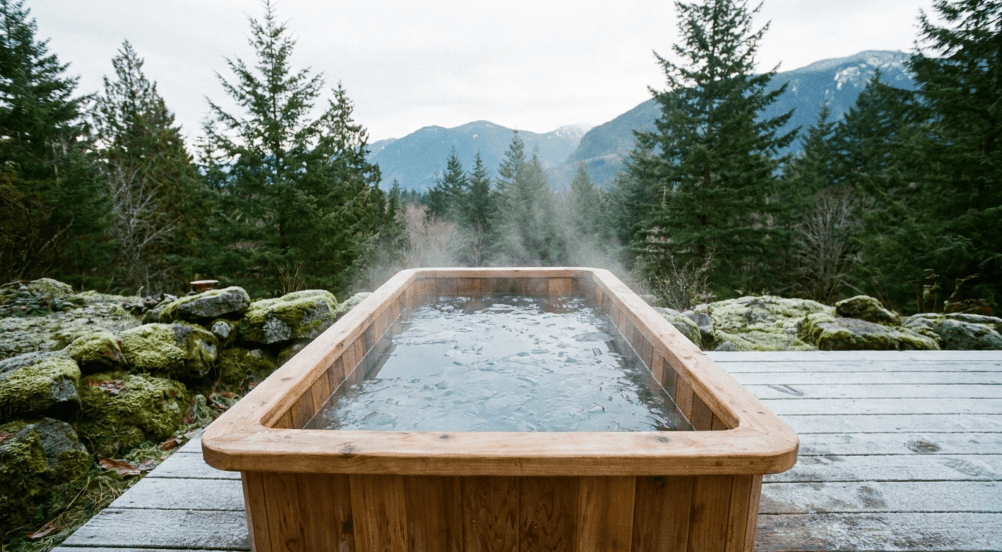
On a tight budget, heat-treated hemlock is the more practical shell material for a cold plunge, typically running 15 to 30 percent less than a comparably sized cedar build without giving up much on durability. Cedar still makes sense if you want the longest possible service life outdoors without recoating, or if the classic reddish grain and lower resin scent matter to you enough to pay the premium. Both woods, assembled well, handle years of daily filling and draining without structural trouble.
Why Does Wood Species Even Matter for a Tub That’s Mostly Water?
A cold plunge shell sits wet more often than it sits dry, cycling between full and drained for cleaning, refilling, and filter servicing. That constant moisture swing is what rots ordinary construction lumber within a couple of seasons, so the wood inside a plunge shell has to resist decay, hold its shape as it swells and contracts, and keep tight joints at the staves without a chemical soak. Only a short list of species clears that bar affordably, which narrows a budget shopper’s real choice down to cedar and heat-treated softwoods like hemlock or occasionally spruce.
What Cedar Brings to a Budget Build, and Where It Costs You
Western red cedar carries natural oils that resist rot and insects without any added treatment, the same property that has made it a go-to for outdoor decking for decades. Left unsealed, it develops a silvery patina within a year or two outdoors, which is purely cosmetic. Its downside on a budget build is straightforward: raw material cost. Clear, tight-grained cedar stock commands a premium over faster-growing softwoods, and that premium shows up directly in the finished tub’s price tag, often the single biggest line item separating a cedar model from a hemlock one of the same size.
What Heat Treatment Actually Buys You in Hemlock
Heat-treated hemlock goes through a kiln process, usually somewhere in the 350 to 430 degree Fahrenheit range, that drives moisture and sugars out of the wood and changes its cell structure so it swells and shrinks less as humidity changes. That process gets a fast-growing, widely available softwood most of the way to cedar’s practical performance at a noticeably lower material cost. New hemlock has a toasted color and a faint smoky smell that fades within the first few months of outdoor use, and some batches come out a touch more brittle than cedar, which matters mainly during assembly rather than once the tub is filled.
How Much Does the Wood Choice Actually Save on a Full Build?
On a single-person round tub, the wood premium for cedar over hemlock commonly adds a few hundred dollars to the total; on a larger multi-person build, where more board feet go into the staves, that gap widens further. For someone pricing a first plunge against a firm budget ceiling, choosing hemlock over cedar is often enough on its own to bring a build within reach without downsizing the tub or skipping a proper chiller. It is one of the few decisions in a plunge build where the cheaper option is not really a compromise on core function.
Where Should a Tight Budget Actually Go First?
Once the wood decision is settled, the next question is where the rest of a limited budget does the most good: a mid-size chiller that holds temperature reliably matters more day to day than the wood species does, and a basic sand or cartridge filter keeps water usable between changes without the ongoing cost of buying ice. Pricing a few complete packages side by side, rather than shopping wood and chiller separately, tends to reveal where a given manufacturer is padding the number. Browsing current listings and package pricing at SweatDecks.com alongside a couple of other sellers gives a reasonable sense of what a hemlock-shell package should actually cost before you commit to one.
Does Either Wood Change How Well the Chiller Holds Its Set Point?
Not directly. The chiller controls water temperature regardless of what the shell is built from, and neither cedar nor hemlock insulates meaningfully better than the other at typical stave thickness. What does change is how much the compressor has to work between cycles, which comes down more to lid quality, wall thickness, and whether the tub sits in sun or shade than to species. A budget hemlock shell with a well-fitted insulated lid holds temperature just as consistently as a pricier cedar one without a lid upgrade.
Is Buying a Used or Discontinued Shell Worth the Risk?
Secondhand cold plunge shells show up periodically in local listings, often from someone who tried the routine and stopped, and can run 40 to 60 percent below new pricing for either wood type. The savings are real, but so is the risk: check the staves closely for cupping, gaps at the joints, and soft spots near the base before buying, since a shell that has sat empty and dry for a season can develop warping that a filled, actively used tub never would. A hemlock shell in good condition is a safer secondhand bet than cedar in most cases, since its dimensional stability from the heat treatment holds up better through a period of neglect than cedar’s natural oils do once they have dried out. Asking whether the chiller or pump is included, and testing it before paying, matters just as much as inspecting the wood itself.
What Does the Research Actually Say, and Does Wood Choice Touch Any of It?
None of the physiological evidence around cold water exposure has anything to do with shell material. A 2025 systematic review and meta-analysis in PLoS One found the overall evidence for cold-water immersion mixed across a range of wellbeing outcomes, not uniformly positive. A 2012 Cochrane review associated cold-water immersion with reduced perceived muscle soreness after exercise, and a 2023 meta-analysis in Frontiers in Physiology reported a comparable modest association with short-term recovery. All three studied water temperature and immersion time, not the tub itself, which is a useful reminder that the wood question is a budget and durability decision, not a health-outcomes one.
Frequently Asked Questions
Is heat-treated hemlock strong enough for a cold plunge that’s used daily? Yes. The thermal treatment process is specifically what gives hemlock the dimensional stability to handle a shell that stays wet most of the week, and daily use does not shorten its working life in any meaningful way compared to occasional use.
Does a cedar tub need to be sealed every year to stay on budget? No. Cedar’s natural oils do most of the protective work on their own, and skipping a sealant just means the wood weathers to a gray patina faster, which is cosmetic rather than a structural risk.
Can you buy an unfinished shell and stain it yourself to save money? Some manufacturers sell unfinished or self-assembly shells at a discount, and staining or sealing it yourself is a realistic weekend project that trims a noticeable amount off the total cost.
Will a budget hemlock shell hold water as well as a pricier cedar one? A properly built hemlock shell with tight stave joinery holds water just as well as cedar; leaks are almost always a construction or assembly issue rather than a species issue.
References
- Effects of cold-water immersion on health and wellbeing: A systematic review and meta-analysis, PLoS One, 2025
- Cold-water immersion (cryotherapy) for preventing and treating muscle soreness after exercise, Cochrane Database of Systematic Reviews, 2012
- Effects of cold water immersion after exercise on fatigue recovery and exercise performance: meta analysis, Frontiers in Physiology, 2023