Why Is Industrial Humidity Control Important?
Humidity control is an essential part of many industrial manufacturing processes. Excess moisture in the air can affect raw materials, product consistency, equipment performance, packaging quality, and the reliability of production environments. Industries that handle moisture-sensitive substances often require environmental conditions that ordinary ventilation or air conditioning cannot maintain consistently.
Temperature control alone does not always provide the required level of humidity management. Refrigeration-based systems remove moisture by cooling air, but some industrial applications require lower dew points or more precise humidity control. Desiccant dehumidification offers an alternative by removing water vapor through moisture-adsorbing materials.
Businesses evaluating a dehumidifier for industrial use should consider their process requirements, moisture load, airflow, operating temperature, and required humidity level. Bry-Air provides industrial desiccant dehumidification systems designed for continuous moisture removal and configurable air handling across different applications.
What Problems Can Excess Humidity Cause in Industrial Facilities?
Understanding the effects of moisture helps businesses determine where dedicated humidity control may be necessary. The risks vary according to the materials being processed, the manufacturing method, and the environmental conditions.
Product Quality and Material Stability
Some raw materials absorb moisture from the surrounding air. This can affect their physical properties, flow characteristics, storage stability, or suitability for further processing. Powders may become difficult to handle, while moisture-sensitive components may experience changes that affect product quality.
Humidity can also influence drying, coating, packaging, and other manufacturing operations. Maintaining appropriate environmental conditions helps reduce unwanted variability and supports repeatable production processes.
The required humidity range should be established using product specifications, process requirements, and relevant technical guidance. A dehumidifier should then be selected to support those requirements rather than relying on a general humidity target for every application.
Equipment Corrosion and Facility Protection
Moisture can contribute to corrosion when susceptible metal surfaces are exposed to suitable environmental conditions. Over time, corrosion may affect equipment reliability, electrical connections, stored components, and maintenance requirements.
Managing humidity can help reduce moisture-related risks, although it does not eliminate the need for protective coatings, suitable equipment enclosures, cleaning, or preventive maintenance.
Industrial facilities should assess humidity alongside temperature, ventilation, condensation risks, and the condition of building materials. A comprehensive environmental control strategy is more effective than relying on a single piece of equipment to address every moisture-related problem.
Packaging and Storage Challenges
Packaging materials may respond differently to environmental moisture. Paper, cardboard, and certain other materials can lose strength or change dimensions when exposed to unsuitable conditions. Some products also require controlled humidity during storage to maintain their specified quality.
Humidity management should extend beyond the production area when storage and packaging operations have similar environmental requirements. Monitoring conditions across relevant zones can help identify fluctuations and determine whether existing controls are sufficient.
How Do Industrial Desiccant Dehumidifiers Work?
Desiccant dehumidifiers remove water vapor by passing air through a material that adsorbs moisture. This process differs from refrigeration-based dehumidification, which generally relies on cooling air to condense water vapor.
Moisture Removal Through a Desiccant Rotor
In a rotary desiccant dehumidifier, process air passes through a rotating wheel containing moisture-adsorbing material. The desiccant captures water vapor, and the treated air leaves the process section with a reduced moisture content.
The wheel rotates continuously between process and regeneration sections. In the regeneration section, heated air removes the accumulated moisture from the desiccant so that it can continue absorbing water vapor.
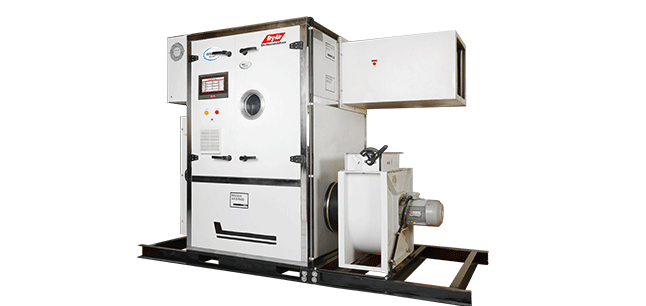
Bry-Air’s FLi Series uses an EcoDry metal silicate desiccant rotor and is designed for continuous industrial dehumidification. The product range can be configured with additional air-handling components to meet application-specific requirements.
Regeneration and Air Treatment
Regeneration restores the moisture-removal capacity of the desiccant. The heated regeneration airstream carries the removed moisture away from the system, allowing the rotor to continue operating.
System performance depends on several factors, including inlet air conditions, airflow, regeneration settings, and the required outlet humidity. Selecting an appropriate heat source and operating configuration is important for balancing performance with energy consumption.
Industrial systems may also require filtration and temperature management. Depending on the application, pre-cooling, post-cooling, and bypass arrangements can be incorporated to support the required air-handling conditions.
What Should Businesses Consider When Selecting an Industrial Dehumidifier?
Equipment selection should begin with an engineering assessment of the application. Comparing equipment based only on airflow or nominal capacity may overlook important differences in operating conditions and moisture-removal requirements.
Airflow, Moisture Load, and Required Humidity
The necessary airflow depends on the size of the controlled space, air leakage, ventilation rates, process emissions, and the amount of moisture entering the environment. The target humidity level and operating temperature also influence equipment performance.
Bry-Air’s FLi Series lists process airflow capacities ranging from 2,500 to 25,000 cubic metres per hour. However, the appropriate model cannot be determined by room size or airflow alone. The expected moisture load and required outlet conditions must also be evaluated.
A qualified application assessment helps establish the capacity, configuration, and operating parameters needed for the intended process.
Filtration and Temperature Management
Air filtration may be important where airborne particles need to be controlled alongside humidity. Pre-filters and after-filters can be selected according to the application’s air quality requirements and the intended system arrangement.
Temperature management is another consideration. Pre-cooling can reduce the temperature of incoming air before it enters the desiccant section, while post-cooling can help adjust the temperature of treated air. These options may be useful when both humidity and temperature must remain within defined limits.
The appropriate arrangement depends on the process conditions, available utilities, and required air quality. Filtration and cooling options should be specified according to the complete application rather than selected independently.
Controls, Monitoring, and Maintenance
Humidity sensors and control systems help operators monitor environmental conditions and assess whether the required operating range is being maintained. Data logging can also help identify recurring fluctuations or changes in system performance.
Maintenance requirements should be reviewed before installation. Filter inspection, sensor checks, airflow verification, and servicing of mechanical and regeneration components contribute to reliable operation.
A maintenance schedule should follow the manufacturer’s recommendations and account for operating hours, environmental conditions, and the system’s configuration. Persistent deviations from the required humidity level should be investigated to identify the underlying cause.
How Does a Dehumidifier for Pharmaceutical Industry Applications Support Quality?
Pharmaceutical manufacturing often involves materials and processes that require carefully controlled environmental conditions. Humidity can influence powder handling, tablet production, coating, capsule manufacturing, packaging, and the stability of moisture-sensitive products.
A dehumidifier for pharmaceutical industry applications should therefore be selected according to the specific process, product requirements, facility design, and applicable quality standards. Bry-Air identifies pharmaceutical uses that include clean rooms, dry powder and vial filling, gelatin processing, tablet coating, compression, and packaging.
Supporting Controlled Manufacturing Environments
Different pharmaceutical processes may require different humidity and temperature ranges. Powder handling, for instance, can be affected by moisture absorption, while certain coating and packaging operations require stable environmental conditions for consistent processing.
Humidity-control equipment should be integrated with the facility’s broader environmental control strategy. This includes appropriate air distribution, filtration where required, monitoring, and coordination with heating, ventilation, and air conditioning systems.
The target conditions should be defined by the process and product requirements. A single humidity setting should not be assumed to suit every pharmaceutical manufacturing area.
Coordinating With Quality and Compliance Requirements
Pharmaceutical facilities must consider applicable regulatory requirements, documented procedures, and quality management systems when designing controlled environments. Dehumidification equipment alone does not establish compliance or guarantee product quality.
The complete system may require documented design specifications, qualification activities, calibrated monitoring instruments, maintenance records, and verification that the required environmental conditions can be achieved consistently.
Equipment materials and construction should also suit the intended area. Where necessary, specialized internal surfaces, filtration arrangements, and cleanability requirements should be reviewed during the engineering stage.
Evaluating System Performance
Before selecting a system, pharmaceutical manufacturers should define measurable acceptance criteria. These may include required humidity ranges, temperature limits, airflow requirements, monitoring expectations, and operational reliability.
Performance should be assessed under representative operating conditions, with appropriate attention to fluctuations caused by production activities, personnel movement, and incoming air. Regular monitoring helps identify deviations so that corrective action can be taken through established procedures.
Conclusion
Industrial dehumidification helps manufacturers manage moisture-related risks, protect materials, and maintain environmental conditions required for reliable production. Effective system selection depends on the moisture load, airflow, target humidity, temperature, air quality, and operating requirements of the facility.
Desiccant technology can support applications that require continuous moisture removal, while filtration, cooling, controls, and monitoring can be incorporated according to the specific process. Pharmaceutical facilities also need to coordinate humidity control with their quality systems, documented requirements, and applicable regulatory standards.
Bry-Air offers industrial dehumidification solutions, including the FLi Series, for a range of manufacturing and process environments. If your facility needs a humidity-control solution tailored to its technical requirements, Contact Us to discuss your application and explore suitable industrial dehumidification options.